
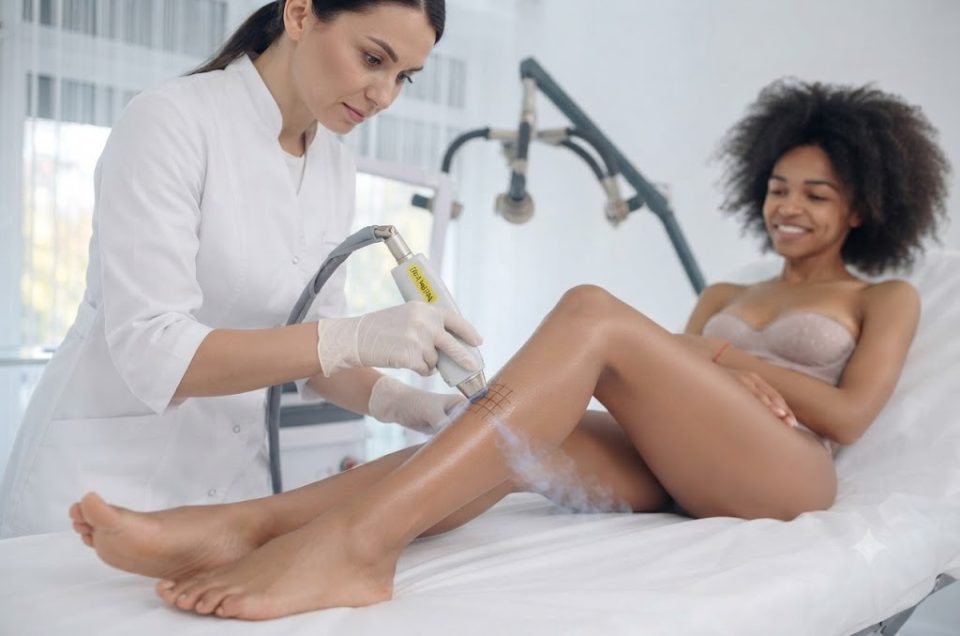
Anyone with a deeper skin tone has likely heard the warnings. Laser hair removal used to carry real risks for melanin-rich skin, including burns, scarring, and patches of lasting hyperpigmentation. Asking if laser hair removal is safe for dark skin in 2026 returns a much clearer answer today, and the short version is yes. With the right wavelength matched to the right Fitzpatrick skin type, the treatment is safe and effective across the full range, from type I to type VI.
The shift comes down to technology, not biology. Older systems relied on shorter wavelengths that could not distinguish between the pigment in the hair follicle and the pigment in the surrounding skin. Newer systems built around the Nd:YAG laser solved that problem by penetrating deeper and skipping the surface entirely.
Is Laser Hair Removal Safe for Dark Skin in 2026?
Yes. Laser hair removal is safe for dark skin in 2026 if the clinic uses an Nd:YAG laser, which operates at a 1064 nm wavelength that bypasses the melanin in the upper layers of the skin. The historical risk came from older devices like IPL and Alexandrite systems that absorbed too much pigment from the epidermis itself, generating heat in the wrong place.
A lot of the fear around the procedure traces back to the early 2000s, when most clinics offered only one type of laser and the patient was expected to fit the machine. That mismatch caused the burns and discoloration the industry is still trying to live down. Today, the conversation should start with the device a clinic owns and the training of the person using it. Peer-reviewed research indexed on PubMed backs up the safety profile of the Nd:YAG approach for skin of color.
What Type of Laser Is Best for Dark Skin?
The Nd:YAG laser, calibrated to 1064 nm, is regarded as the best laser for dark skin hair removal that the industry currently offers. Its longer wavelength penetrates deeper into the follicle without scattering heat into the surrounding tissue, which is what protects melanin-rich skin from damage.
Most modern aesthetic centers carry more than one wavelength so they can match the device to each patient rather than the other way around. That is the standard now, and it is the framework behind safe laser hair removal treatments at clinics serving diverse communities.
Understanding the Fitzpatrick Scale
The Fitzpatrick scale ranks skin from type I, the lightest, to type VI, the deepest. It was developed in the 1970s to predict how skin responds to ultraviolet light, but it has become the standard reference for laser eligibility too. The more melanin in the skin, the more carefully a laser must be selected, because melanin absorbs laser energy and converts it to heat. The wrong wavelength on type V or VI skin can scorch the surface long before the energy ever reaches the hair root.
Comparing Wavelengths by Skin Type
A short reference table helps clarify why one device is not enough for a diverse patient base.
| Laser Type | Wavelength | Best Skin Type Match | Why It Works |
| Alexandrite | 755 nm | Fitzpatrick I to III | Strong absorption suited to lighter melanin |
| Diode | 810 nm | Fitzpatrick III to V | Mid-range penetration for medium tones |
| Nd:YAG | 1064 nm | Fitzpatrick IV to VI | Long wavelength that bypasses surface melanin |
The takeaway is that a single-wavelength clinic limits the people it can safely treat. A dual or multi-wavelength setup expands the patient base without compromising on safety. This is part of why patients seeking laser hair removal in multicultural South Florida neighborhoods tend to prioritize clinics that own both Alexandrite and Nd:YAG systems.
Does Laser Hair Removal Cause Hyperpigmentation?
Laser hair removal causes hyperpigmentation only if the wavelength is wrong for the skin being treated. Using the Nd:YAG laser on Fitzpatrick types IV through VI virtually removes the risk because the 1064 nm energy travels past the surface pigment and concentrates in the follicle itself.
Most cases of post-treatment darkening are not from the laser alone. Sun exposure in the days following a session, inflammation already present in the skin, or skincare products with active acids in the lead-up can all contribute. Pre-treatment guidance from the provider matters as much as the laser they use. Patients exploring aesthetic laser services in diverse South Florida communities should ask about pre-care protocols before the first session is booked.
Why the Candela GentleMax Pro Handles All Skin Types
The Candela GentleMax Pro is widely treated as the gold standard for all-skin-type laser hair removal because it houses both an Alexandrite 755 nm laser and an Nd:YAG 1064 nm laser in one device. That allows the practitioner to switch wavelengths within a single appointment, matching the energy to each patient rather than committing to one mode.
For a clinic serving patients of South Asian, Caribbean, African, Middle Eastern, and Latin descent, the Candela GentleMax Pro all skin types capability is what makes the workflow practical. The device also has a built-in cryogen cooling system that delivers a controlled burst of cold air before each pulse, which protects the surrounding skin and keeps the session more comfortable.
How Many Sessions Do You Need for Laser Hair Removal?
Most patients require between six and eight sessions spaced four to six weeks apart to reach permanent hair reduction. The number is not arbitrary. It traces back to the biology of how hair grows.
The Hair Growth Cycle
Hair on the body cycles through three phases. The anagen phase is active growth, the catagen phase is transition, and the telogen phase is rest. Laser energy can damage a follicle only during anagen, because that is the phase where the hair shaft is connected to the follicle by living tissue. At any moment, only a portion of the hair on any given area is in anagen. Spacing sessions four to six weeks apart catches each follicle in its growth phase across the full treatment course, which is why one or two appointments will never deliver final results no matter the device used.
Maintenance sessions every six to twelve months can keep results in place once the main course is complete. Hormonal shifts, pregnancy, and certain medications can prompt scattered regrowth even years later, so the maintenance schedule is patient-dependent rather than fixed.
What This Means for Patients Choosing a Clinic
The single most important question a patient with deeper skin can ask is which lasers the clinic owns and which one the practitioner plans to use on them. A clinic that names the Nd:YAG, explains the Fitzpatrick scale without being prompted, and adjusts settings based on real-time skin response is the clinic worth booking with. The technology has caught up with the diverse population that laser hair removal was originally not designed for, and 2026 patients of every background can pursue results with reasonable confidence.
-

Solea Medical Spa and Beauty Lounge your first and final destination for all your beauty and medical needs.
info@soleabeautylounge.com